

LinkaGoGo, my online bookmark manager, can show its pages as markdown to a markdown browser. For shared (public) folders and bookmarks, that has worked fine from the start. For private ones, you had to give the browser an API key. Mardo, my markdown browser and editor, has a place for that, Site Credentials, but copying a key out of one app and into another is a hassle. I wanted to make it easier.
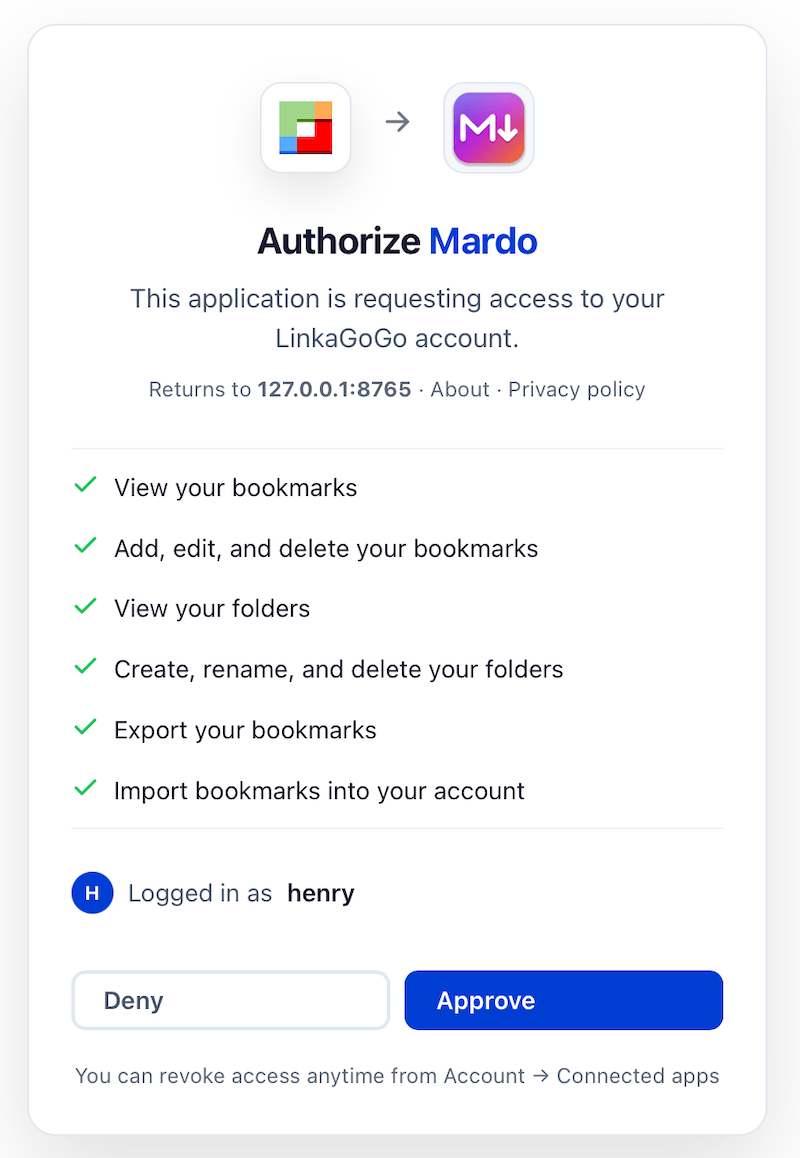
I looked at a few options and settled on OAuth, the standard way an app asks a website for permission on your behalf. It is a good fit for this case: a desktop app (Mardo) that needs to sign in to a web service (LinkaGoGo). LinkaGoGo already had most of the server side. It needed only a few tweaks. Mardo got the client side.
Now when Mardo opens a private LinkaGoGo page and you aren't signed in, the page offers a "Sign in with LinkaGoGo" button. Press it, and your browser opens LinkaGoGo's own page asking whether Mardo may have access. Approve, and you're back in Mardo with the page open. There is nothing to copy or paste. Mardo never sees your password, and you can sign out of LinkaGoGo from Mardo at any time.
It isn't specific to LinkaGoGo. Any site that publishes its sign-in details in the standard way can work like this, so I'm hoping to try it with other services next.
OAuthauthorizationsign inLinkaGoGoMardomarkdownmarkdown browserbookmarksAPI keyprivate bookmarks