
I'm Henry van den Broek, an indie developer building apps I want to use: LinkaGoGo, a 25+ year-old bookmark manager; Reken, a reactive HTML framework; Mardo, a markdown editor; Weft, a personal space on the social web; plus word games and cycling tools.

Born in Amsterdam, I spent my career in enterprise software at IRI Software and Oracle before moving to the US. I've been building full time since retiring in 2022.

Off the bike I code, cook and blog; on it, I've ridden Paris-Brest-Paris twice and race cyclocross.

Posts tagged markdown · All posts · Feed for this topic

image

To make it easier to create and edit Wako-based wiki pages, I added OAuth support to Wako. Now I have three markdown-server products that interoperate easily with Mardo, the Markdown Browser and Author:

  • LinkaGoGo: the original online bookmark manager.
  • Wako: a Markdown wiki in one Go binary.
  • Weft: write on the open web, from a place that is yours.

The last two, Weft and Wako, provide write support that Mardo works with.

markdownbonbonmarkdownwebmardolinkagogowakoweftoauthwikiindieweb
Inspired by the markdown web I created a markdown based wiki application. I ran it locally for myself for a while, but thought I should share it and now made the repo public. Includes an easy docker install. Hope to host demo server soon.

wako: a Markdown wiki in one Go binary

Plain, portable Markdown in SQLite. Spaces, history, kanban boards, pictures, pdf, AI through MCP. One static program.

wako.henryvandenbroek.com wako on github

wikimarkdownSQLiteGoself-hostedkanbantodotablesmarkdownweb

Mardo 0.19.x

image

Signing in and editing

  • Sign in with a site (OAuth): a site that offers it signs you in on its own page, and Mardo keeps the token in your keychain and renews it. It works on desktop, iPhone and Android.
  • Sign in to edit:
    • On a page the server won't let you change, the source view has a "Sign in to edit" bar.
    • The ☰ menu says "Sign in with …" in either view, and choosing it starts the sign-in.
    • Signing out reloads the page and takes away the editing options.
  • Add and delete pages: where a server allows it (Allow: POST or DELETE), the right-click menu and the ☰ menu offer "New … here…" and "Delete this page…". Which kinds of page to offer (a post, a wiki page) and their starting template come from bonbon.json under a mardo key.
  • Safer saves: a save, add or delete is never sent on when a server redirects it.

Search and address bar

  • Site search: a site's own search (urlSearch in bonbon.json) works in either mode. Outside Bonbon mode, only a search on the site's own host is used.
  • Hints and selection: a magnifier and the site's name in the address bar show when site search is on. A click in the address bar selects the whole address.

Navigation and reading

  • Back and Forward: they remember the anchors you followed, and a long press lists the pages behind.
  • Tabs and bookmarks: a tab menu, addresses for headings, and a bookmarks toolbar under Send to.
  • Open in browser: an external link opens in the browser. That never worked on iPhone before this release.
  • Data links: markdown in a data: link of an HTML page now has its relative links resolved against the page's address.

Where it shipped

  • 0.19.2: this is in review at both stores, and it is the release for macOS, Windows and Linux. It has everything above except the last item.
  • Data-link fix: this is on main only. It will go out with 0.19.3.
  • Earlier tags: v0.19.0 and v0.19.1 were interim releases and are superseded by 0.19.2.

mardomarkdownrelease-notesoauthbonbonmarkdownweb

Weft now supports writing for OAuth clients. You can:

  • Edit a post
  • Create a post
  • Delete a post

Mardo looks for the Allow: header. When it sees PUT, POST or DELETE, it knows it can make changes on the server.

Weft also sends and accepts metadata, such as the title, as frontmatter at the top of a post. This post as an example:

title: Very exciting, a new post with Weft and Mardo working together
keywords: [markdown, publishing, authoring]
slug: weft-and-mardo-working-together

The markdownweb is now becoming full circle; write and read.

markdownpublishingauthoringmarkdown web

Mardo, a markdown browser and authoring tool, needed to organize and store bookmarks. Made sense to store them in a markdown file. The Open Markdown Bookmark Format (OMBF) defines how folders and bookmarks are stored. It also describes how vendors can extend it with their own attributes.

General · hbroek/open-markdown-bookmark-format

The specification has its own website (https://open-markdown-bookmark-format.henryvandenbroek.com). For feedback, comments, or if you (want to) support it, visit the github repository open-markdown-bookmark-format.

markdownbookmarksmardomarkdown webbonbonweb

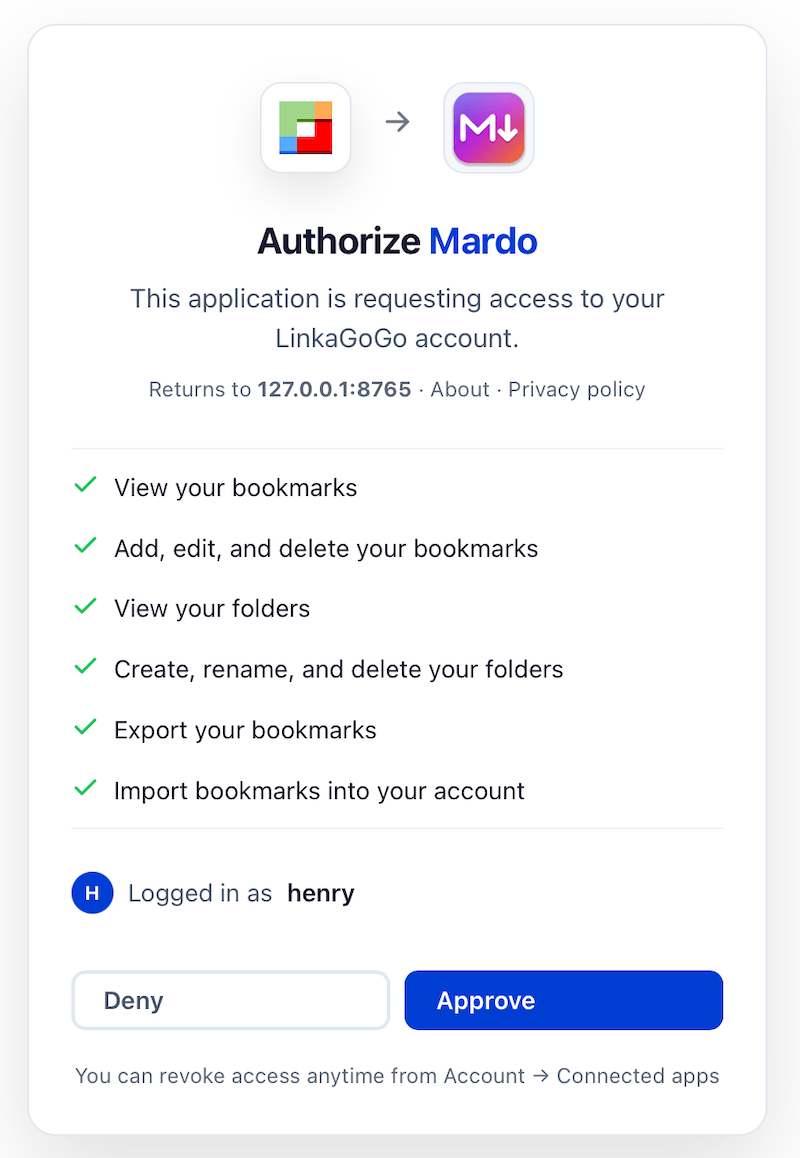
LinkaGoGo, my online bookmark manager, can show its pages as markdown to a markdown browser. For shared (public) folders and bookmarks, that has worked fine from the start. For private ones, you had to give the browser an API key. Mardo, my markdown browser and editor, has a place for that, Site Credentials, but copying a key out of one app and into another is a hassle. I wanted to make it easier.

LinkaGoGo authorize Mardo dialog

I looked at a few options and settled on OAuth, the standard way an app asks a website for permission on your behalf. It is a good fit for this case: a desktop app (Mardo) that needs to sign in to a web service (LinkaGoGo). LinkaGoGo already had most of the server side. It needed only a few tweaks. Mardo got the client side.

Now when Mardo opens a private LinkaGoGo page and you aren't signed in, the page offers a "Sign in with LinkaGoGo" button. Press it, and your browser opens LinkaGoGo's own page asking whether Mardo may have access. Approve, and you're back in Mardo with the page open. There is nothing to copy or paste. Mardo never sees your password, and you can sign out of LinkaGoGo from Mardo at any time.

It isn't specific to LinkaGoGo. Any site that publishes its sign-in details in the standard way can work like this, so I'm hoping to try it with other services next.

OAuthauthorizationsign inLinkaGoGoMardomarkdownmarkdown browserbookmarksAPI keyprivate bookmarks

Mardo, a week of busy work 🦡

Mardo is a free, open-source app for reading and writing the web as plain text. Many pages today are written in markdown, a simple way of writing text with a few symbols, such as a # for a heading. Mardo opens those pages cleanly, lets you edit them, and keeps your bookmarks. It's built for people who write online.

image

Since Mardo the Marten joined the website, I've been adding a lot:

  • Bonbon support. Bonbon is a plain-text, markdown-only web started by Dave Winer. Mardo can read it the way it's meant to be read, with arrows to the next and previous post, a site's own search, and pages that reload by themselves when the author changes them.
  • Send to. A new toolbar that sends the page you're reading, or the text you've selected, somewhere else. Post a link to a service, search Google or an AI for your selection, or copy a link neatly formatted. You can make your own, and edit them without leaving Mardo, including on a phone.
  • Page styles. Read in a book-like, newspaper-like or plain style, or use your own.
  • Better writing tools. A live preview next to the editor, a cheatsheet for the symbols, find and replace, and an AI helper that now knows the date and where your cursor is.
  • Pages that live in the address. A whole page can be packed into a single long web address you can copy, share and edit.
  • Now on Android, and on iPhone and iPad.

Where to get it right now

  • Mac, Windows and Linux: version 0.18.0 is on the release page: https://github.com/hbroek/mardo/releases/tag/v0.18.0
  • iPhone and iPad: on the App Store. It's the previous version, and the newest is on its way.
  • Android: submitted to Google Play and in review. I hope it will be out early next week.

More at https://mardo.henryvandenbroek.com

mardomarkdownbonbontextcastingopen sourcewritingbrowsereditorbookmarksandroid